MUSIC THREE WORKS / ANNIE CHENG
MAT111AU
Two original compositions and one audio mixing study by Annie Cheng.
Select a track to listen.
9.13
Original Composition
8.30
Original Composition
8.14
Audio Mixing
THE CREATIVE DESKTOP / ANNIE CHENG
Two original compositions and one audio mixing study by Annie Cheng.
Select a track to listen.
Original Composition
Original Composition
Audio Mixing
A miniature stage built from six layers of laser-cut birch plywood.
A project by Annie Cheng
The Theater Box brings theater, film, and the UCSB landscape into a small, layered stage. Six illustrated panels create physical depth, moving from a theatrical frame and film motifs toward campus landmarks and the coast. The project connects digital modeling with hand-drawn vector artwork and physical assembly.
The subject of each panel was established before modeling. Arranged from front to back, the layers lead the eye through the stage toward the distant landscape.
Curtain and class-of-2026 crest
Camera, reel, and clapperboard
An opening beneath the tower
The campus silhouette
The walk toward the shoreline
Coastal hills and sun
The box structure came first. Modeling the base, front, and side panels established the dimensions of the enclosure and the space required for six inserts. These measurements provided a consistent starting point for the illustrated panels.
Tools: Fusion 360
The Fusion 360 model and the material sheet dimensions informed a set of panel templates generated with ChatGPT. Each outline was checked against the available cutting area, then adjusted to its final scale in Inkscape.
The artwork was drawn directly onto these sized outlines in Inkscape, keeping the illustrated scenes aligned with the physical structure.
Tools: Fusion 360 · ChatGPT · Inkscape
The main design challenge was maintaining legibility when all six panels overlapped. On-screen comparisons tested the relationship between the archway, Storke Tower, and palm trees, checking how their silhouettes remained visible through the layers in front.
Tools: Inkscape
The six panels were laser-cut from birch plywood and glued into the frame. The finished object translates the flat illustrations into a compact stage, with shadows and spacing giving each scene its own depth.
The project required the structure and illustrations to work together across Fusion 360, ChatGPT, and Inkscape. The central lesson was to design each panel in relation to the others: an individual image needed to remain readable as part of the assembled scene.
An interactive installation by Annie Cheng
Tools: Arduino Nano · Arduino IDE · TouchDesigner · Tinkercad
A falling water droplet becomes the trigger for a firework on screen. When it strikes the sensing surface, the point of impact determines which of four screen zones responds. The downward movement of water meets an upward burst of light, connecting a small physical gesture with an expanding digital image.
“The rain that falls is a firework, set off in the sky.”
The installation draws on the rhythms of rain and the brief appearance of fireworks. Its monochromatic imagery directs attention to movement, impact, and the changing relationship between the physical surface and the screen.
Early concept images explored the relationship between a hand-held dropper, a sensing surface, and a responsive screen. These studies established the interaction before the physical prototype and live visual system were built.
Four piezo sensors divide the input surface into four zones. An Arduino Nano compares their analog readings against a threshold and sends the trigger data over serial to TouchDesigner. Each trigger activates the corresponding firework region on screen.
The Tinkercad circuit uses an Uno and piezo components as stand-ins for the physical setup. Each sensor connects to an analog input, A0–A3, with a 1 MΩ resistor across the disc.
Four piezo sensors were positioned in separate quadrants and embedded within a thin layer of AB resin. The arrangement allowed the surface to register impacts from different regions while bringing the sensors into one physical interface.
Embedding the sensors reduced their sensitivity, making calibration an important part of the fabrication process. The physical build and signal processing were adjusted together so that small impacts could produce a usable trigger.
The TouchDesigner network uses Serial DAT, Convert DAT, DAT to CHOP, Math CHOP, Logic CHOP, and CHOP Execute DAT to receive and process the sensor data. Resting values were calibrated for all four sensors, with a threshold to separate impacts from background noise.
The fireworks combine particlesGpu, Bloom, Transform, and a feedback trail. Continuous rain ambience provides a sound bed, while each detected drop triggers an additional impact sound.
Tools: TouchDesigner · Arduino IDE
Peak detection and software calibration helped register weaker signals after the sensors were embedded.
Resting readings changed with the environment. Startup calibration and on-site threshold adjustments improved the response.
A single impact could produce multiple signals. Resetting the output to 0,0,0,0 after each trigger helped prevent repeated firing.
Arduino IDE and TouchDesigner could not use the serial port simultaneously. Port access and mirrored screen positions were resolved before the final run.
Two recordings document the installation in use. Both videos retain their full duration and recorded sound.
The Silent Weight of Social Anxiety is a visual design project that explores the hidden emotional experiences of social anxiety through four posters: Offline, Isolated, No Signal, and Anxiety Always Finds Me First. While social anxiety is often invisible to others, it can create feelings of loneliness, pressure, disconnection, and emotional exhaustion. Drawing from personal experiences, this project uses visual storytelling, symbolism, contrast, and typography to communicate emotions that are often difficult to express through words. Each poster presents a different aspect of social anxiety, from self-isolation and social disconnection to the overwhelming fear that can emerge in crowded environments. Through these designs, I hope to encourage empathy, raise awareness of mental health struggles, and invite viewers to reflect on the invisible challenges many people experience in everyday social situations.
Isolated explores the emotional distance between the individual and the crowd. A dense line of people cuts diagonally across the composition, while a solitary figure occupies the open space at the lower left. The black-and-white palette and contrast between many and one emphasize separation, with negative space reinforcing a sense of loneliness and disconnection.
No Signal uses televisions as a metaphor for social connection. While most screens display the same signal, one remains disconnected, standing out from the group. This image reflects the experience of wanting to belong but feeling unable to connect with others. The bright red warning text symbolizes frustration, emotional exhaustion, and the pressure to appear socially engaged despite feeling isolated inside.
Offline explores the emotional withdrawal caused by social anxiety. A solitary figure sits within a protected space while countless handprints press in from outside, symbolizing social expectations and invisible pressure. The contrast between darkness and light reflects the conflict between the desire for safety and the fear of connection. Although surrounded by opportunities to communicate, the individual remains emotionally disconnected from the world around them.
Anxiety Always Finds Me First portrays the overwhelming nature of social anxiety in crowded environments. A bright figure appears to be falling through a sea of people, suggesting a loss of control and emotional stability. The contrasting movement between the crowd and the falling figure reflects how anxiety can emerge before any other emotion, turning ordinary social situations into moments of fear and uncertainty.
by William Inge
Bus Stop takes place in a small diner during a snowstorm in the middle of the night. Several travelers are forced to stay together while waiting for the road to reopen. As the night continues, tensions rise and relationships between the characters begin to change. The lighting design focuses on the contrast between the warm interior of the diner and the cold winter environment outside. Through color and intensity changes, the lighting supports the emotional development of the characters throughout the night.
The main concept of this lighting design is contrast between warmth and coldness. Inside the diner, warm light creates a sense of safety and intimacy. The outside world is represented with cold blue tones to show the harsh winter environment. As the story develops, the lighting shifts to reflect emotional changes between the characters.
By the end of the play, the lighting becomes softer and brighter to represent reconciliation and a new beginning.
When characters enter through the diner door, a flash of cold light appears from outside. This emphasizes the strong contrast between the warm diner and the freezing environment outside.
When Cherie slaps Bo, the lighting becomes harsh, bright, and cold, highlighting the sudden emotional conflict between the characters.
At the end of the play, when Bo and Cherie reconcile, the lighting shifts to golden warm tones mixed with soft pink, creating a romantic atmosphere that represents emotional resolution.
As morning approaches, the exterior lighting gradually changes from deep blue to soft dawn blue with orange tones, showing the passage of time and the end of the long night.
by Mary Zimmerman
Metamorphoses is a theatrical adaptation of Ovid’s classical myths. The play presents a series of interconnected stories exploring themes of love, loss, transformation, and the relationship between humans and gods.
This design emphasizes the concept of transformation through fluid spatial elements, light reflections, and the symbolic presence of water.
by Steven Sater
This design explores the tension between oppressive social structures and the awakening of individual identity. Through monochromatic space, symbolic architecture, and expressive lighting, the stage reflects the emotional journey of the characters from restriction to transformation.
Spring Awakening is set in late nineteenth-century Germany, a society shaped by rigid moral codes, strict education, religious authority, and limited communication around sexuality. Young people grow up under systems that value obedience over emotional truth, creating an environment where curiosity, desire, and individuality are often suppressed.
At the center of the play is the conflict between institutional control and personal awakening. The young characters begin to question the rules that define their bodies, desires, and futures, yet every attempt at self-discovery is met with punishment, silence, or fear. For this reason, the play is not only about repression, but also about the painful process of awakening—sexual, emotional, and social. Its tragedy emerges from the collision between youth and authority, while its ending still gestures toward transformation and hope.
Aunt Sarah has lived here for 30 years and it hasn’t lost its charm.
She married him because her parents used an abacus bead and the eight signs of fortune. Her husband's family was a Nanyang overseas Chinese businessman (common in Hong Kong in the 1960s), and a divorce would have caused her family to lose their overseas Chinese remittance support.
Neighbors complimented her on her virtue, and her husband's shirts were always snow-white. But they don't know that behind the glamorous life and the happy family that everyone praises, there are many lipstick marks on her husband's shirt that she try to ignore. The only thing left was the numbers on the remittance slips and the letters she sent to her family where she wrote that her mother-in-law and husband treated her very well.
Later the man left for the Nanyang and she still lives in the old house. It was not that she was old-fashioned, but that she had once met someone there who had allowed her to briefly salvage herself from the ruins of an arranged marriage. But in the end he hadn't been able to take her away, and she hadn't been able to break free of her chains, and it was the memories that kept her here now. She always looks back at her life in this house and wonders if she would have ended up differently now if she had been braver.
Tools: Vectorworks
This project presents a Chinese-inspired park landscape model developed in Vectorworks. The design draws from traditional Chinese garden aesthetics, particularly the spatial organization and visual layering found in classical garden environments. The model combines water features, bridges, pavilions, and curved pathways to create a walkable landscape space that emphasizes harmony between architecture and nature.
The research focused on traditional Chinese garden design and waterfront landscapes. Key references included elements commonly found in Jiangnan water towns and classical Chinese gardens, such as curved bridges, pavilion structures, layered pathways, and water-centered spatial compositions. These references informed the overall spatial layout and architectural details of the park model.
The basic terrain and landscape layout were first constructed in Vectorworks. Major elements such as pathways, bridges, pavilions, and surrounding landscape structures were modeled to establish the spatial composition of the park. The design emphasizes flowing circulation and layered viewing perspectives, allowing visitors to move through different landscape scenes.
Tools: Vectorworks
Materials and textures were applied to define different landscape components. Stone textures were used for pathways and bridges, while wood materials were applied to pavilion structures. Water surfaces and vegetation elements were added to enhance the visual realism of the environment.
Traditional lanterns were modeled and placed throughout the park, each containing a red light source. The lantern lighting introduces a warm nighttime atmosphere while emphasizing circulation paths and key architectural elements within the landscape.
Final renderings were generated in Vectorworks to present the completed landscape environment. The rendered views showcase the spatial composition, architectural details, and overall atmosphere of the park design.
Tools: Vectorworks
A digital art series exploring memory, perception, and identity through the lens of Alzheimer’s disease.
“What is the one thing you don’t want to forget?”Explore the project ↓
Created for MAT10, this final compilation brings together a series of digital artworks exploring memory and its fragmentation. The project draws on a recorded interview in which people living with Alzheimer’s disease were asked: “What is the one thing you don’t want to forget?”
Selected excerpts from their responses form the foundation of a visual and sonic montage. Through image, sound, and virtual space, the work reflects on the emotional significance of familiar faces, places, and memories—and the uncertainty that emerges as they become difficult to recognize.
You, in the Fragments explores the relationship between familiarity and recognition through an interactive portrait. Real-time cursor tracking controls the image: as the viewer approaches the subject’s face, its features stretch, blur, and dissolve.
This reversal of proximity and clarity offers a visual metaphor for disrupted recognition. The interaction invites viewers to consider the emotional distance that can arise when a familiar face becomes difficult to place.
This typographic study assembles everyday objects and contrasting materials into the word “Alzheimer.” Each letter becomes a visual association with memory, aging, or communication.
Decaying apples suggest the passage of time and the deterioration of memory, while a telephone evokes an unanswered call and the difficulty of sustaining connection. Together, these objects transform the word into a collection of symbolic fragments.
Two Perspectives examines how changes in memory and perception can alter the experience of home. Familiar furniture is presented alongside distorted counterparts, using deformation and spatial misalignment to make an everyday environment feel unfamiliar.
AI-assisted visual studies developed with Chat AI informed the initial concepts. SuperCraft translated these images into preliminary 3D models, which were then refined and rendered in Blender. The resulting contrasts offer an artistic interpretation of perceptual uncertainty, inviting reflection on the relationship between familiarity, space, and a sense of belonging.
Tools: Chat AI · SuperCraft · Blender
Two objects, two perspectives. Familiar forms become unfamiliar.
This creative coding study uses Processing and Google AI Studio to explore visual representations of change in the brain associated with Alzheimer’s disease. The work approaches these changes as an artistic interpretation, extending the series’ investigation of memory and transformation into a computational medium.
Tools: Processing · Google AI Studio
The Nameless Body is a text-based work inspired by the characters and dialogue of “The Father Trapped in Time.” Structured as a self-introduction, the narrative gradually shifts from coherent self-description to conflicting identities and fragmented language.
As names, relationships, and temporal references become unstable, the text examines the role of language in maintaining a sense of self. It asks how identity is expressed when familiar words and personal histories become difficult to access.
By Noël Coward · Scenic Design
01 / Overview
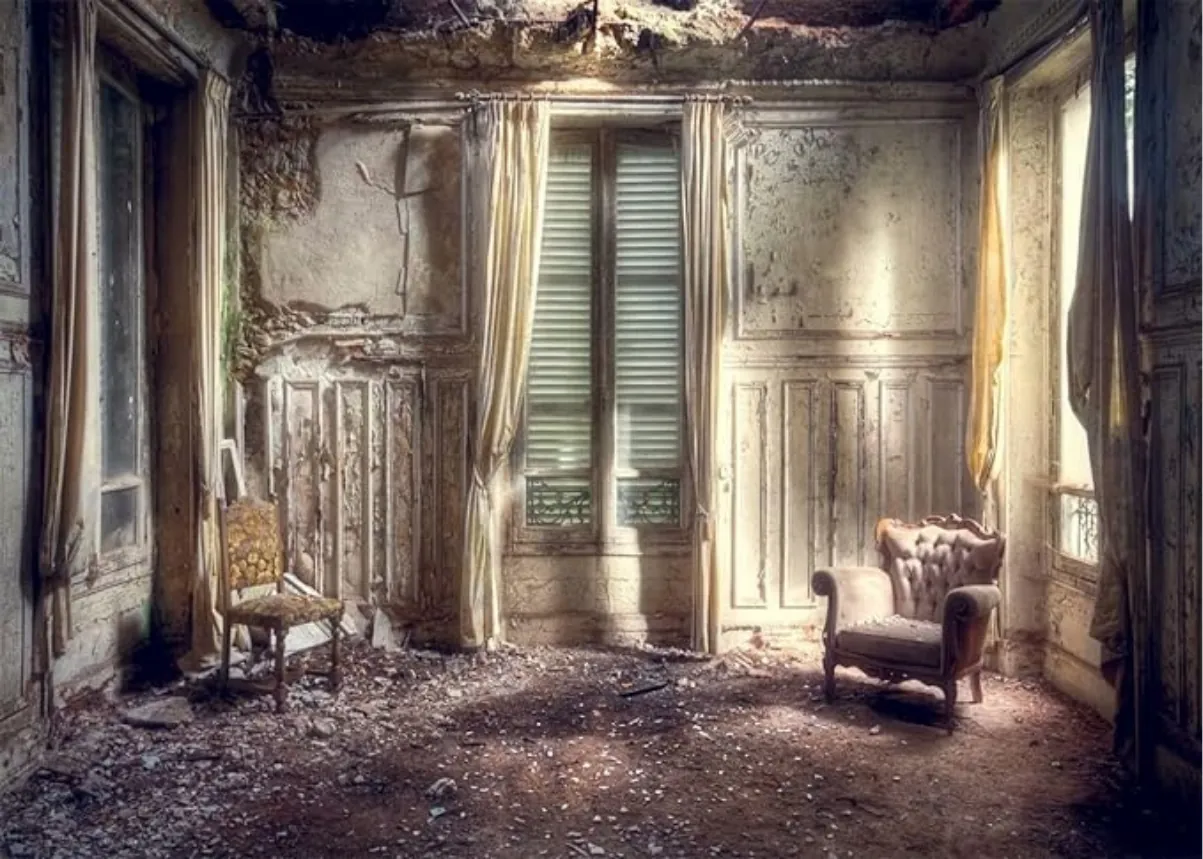
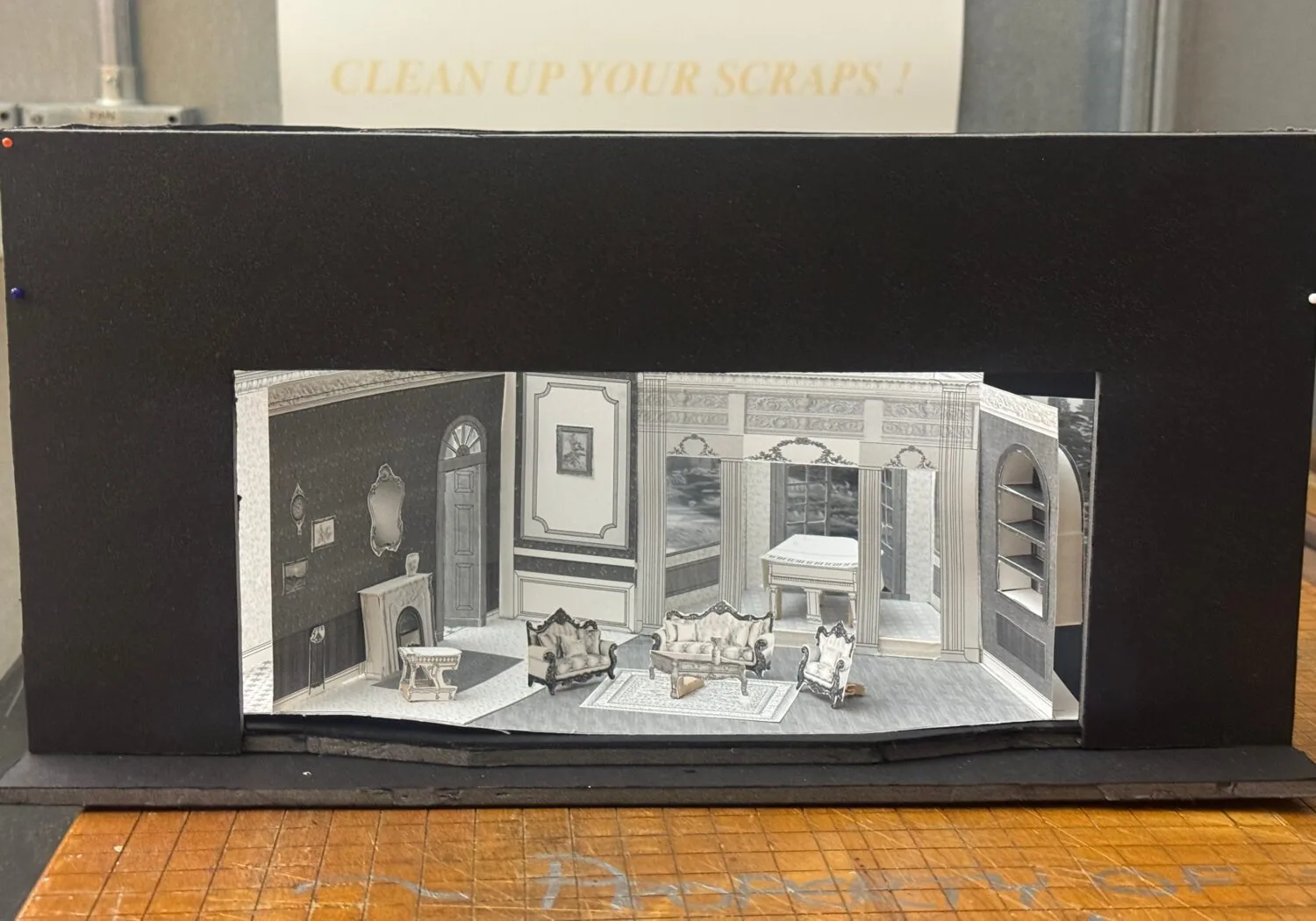
This project is a scenic design for Noël Coward's play Blithe Spirit. The design explores the contrast between everyday domestic life and the supernatural presence of ghosts. Through architectural space, interior elements, and lighting atmosphere, the stage environment reflects both order and disruption within the story.
02 / Design Rationale
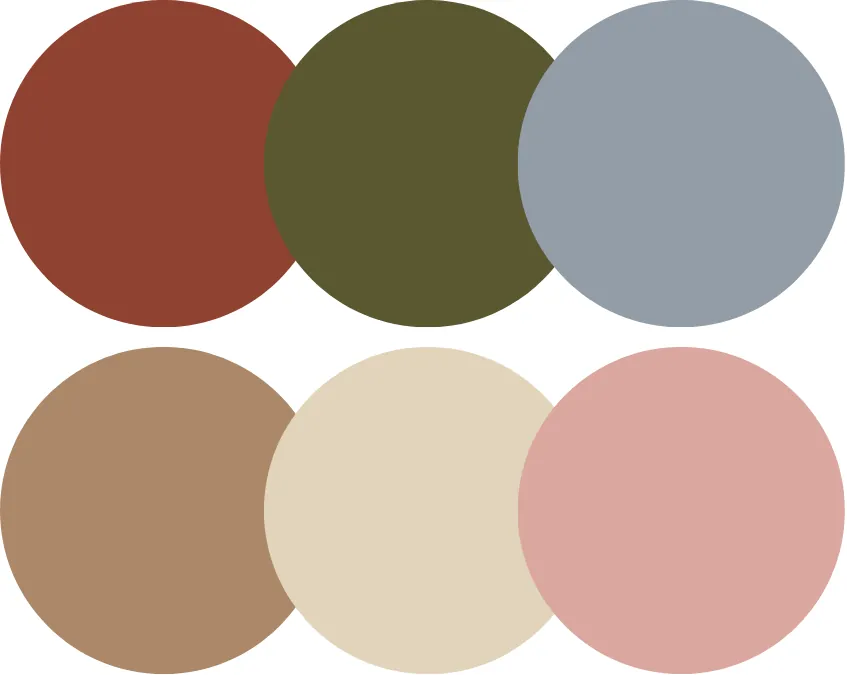
My design originates from the absurd tension between the supernatural and ordinary domestic life in Blithe Spirit. The living room appears elegant and orderly, but subtle disruptions suggest the presence of ghosts.
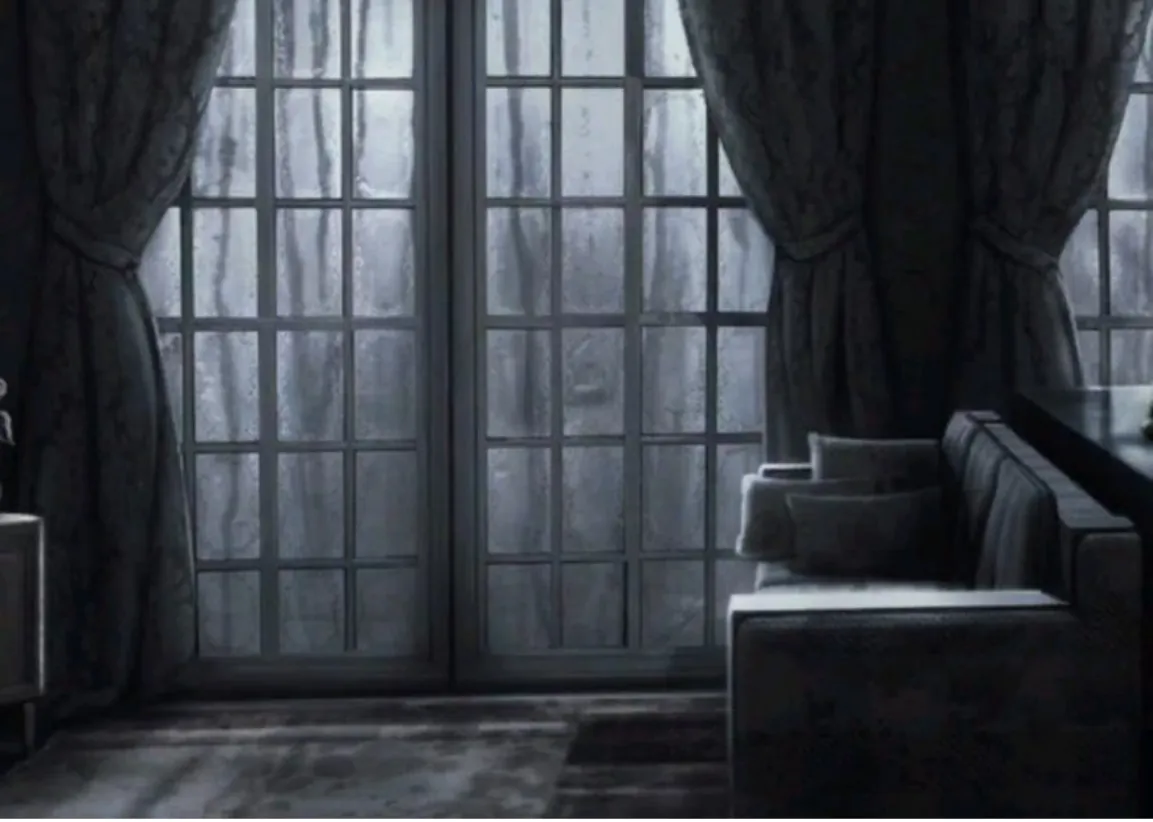
Broken objects, shifting light, and spatial openness emphasize the unstable boundary between reality and the supernatural. Flickering practical lights combine with cold illumination to allow the atmosphere to change without transforming the room into an obviously haunted space.
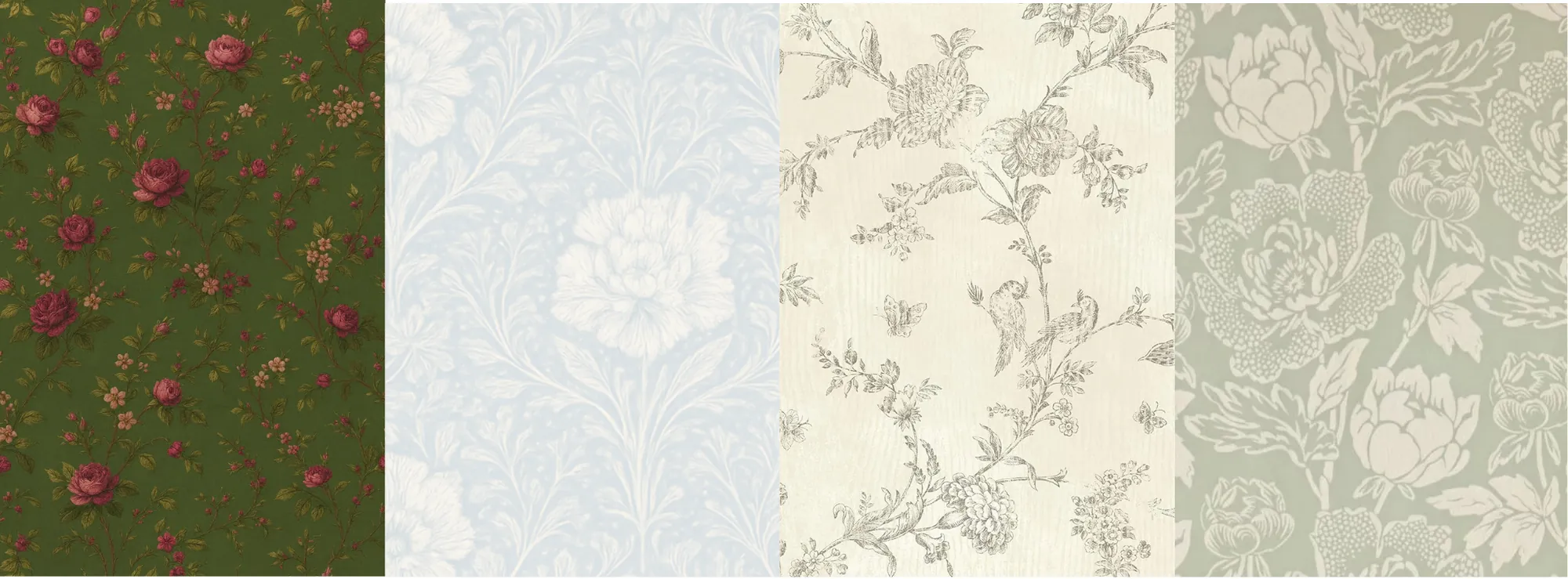
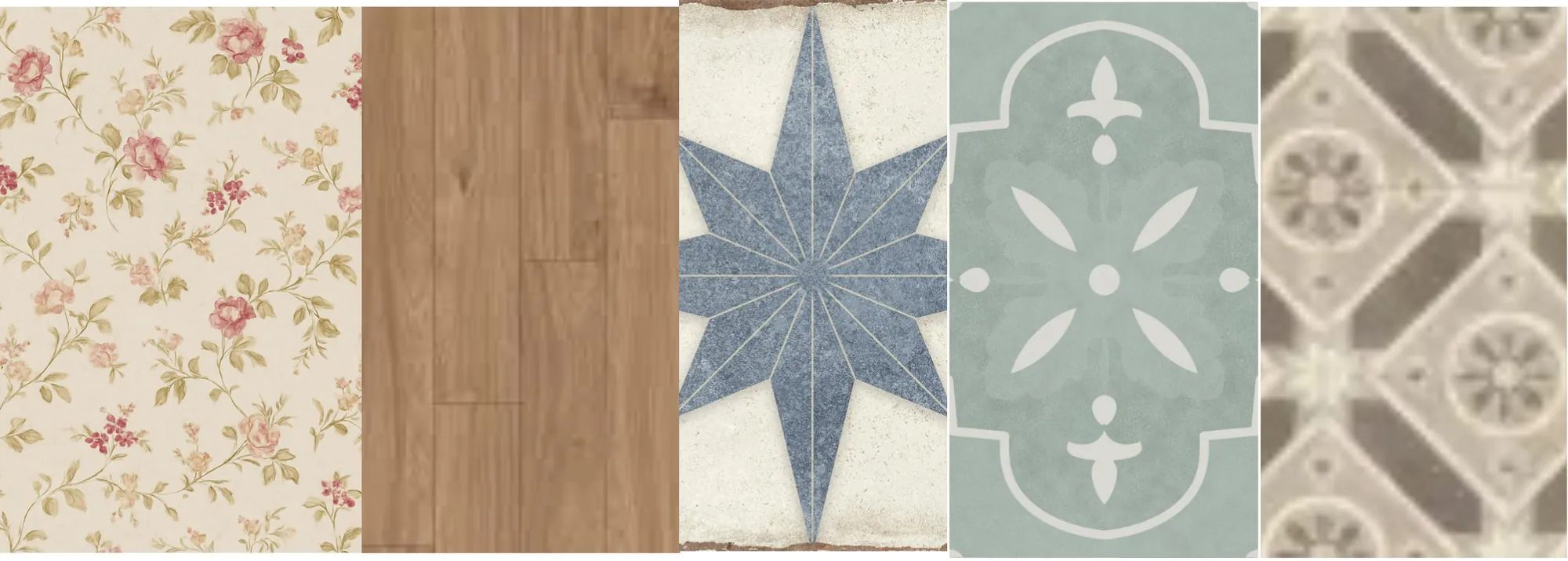
I researched British domestic interiors from the 1940s to understand the visual culture of middle-class homes during the period. Late Art Deco furniture and postwar utility design influenced the arrangement, detailing, and atmosphere of the living room.
03 / Environment & Materials
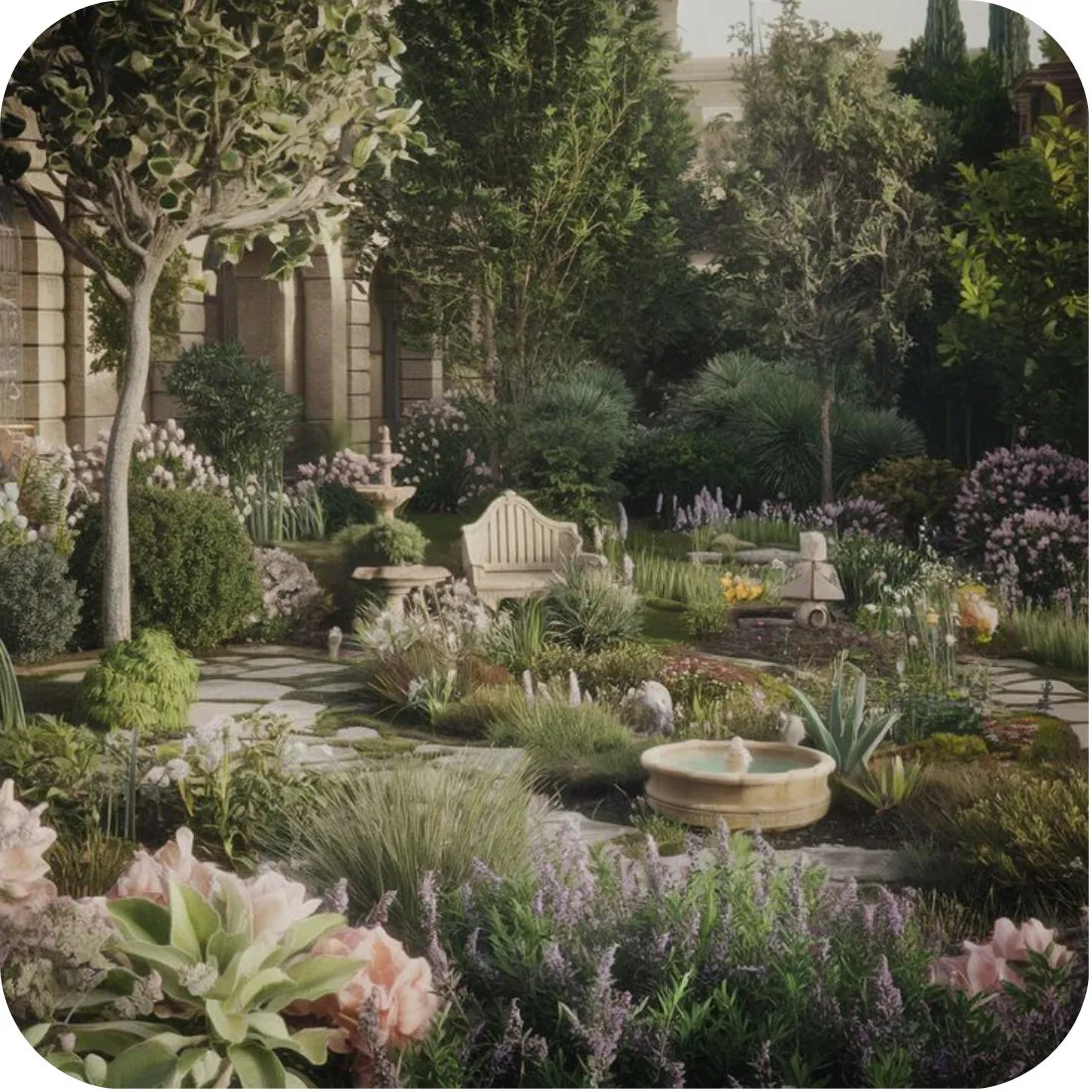
The design reimagines the traditional enclosed living room as a more open and layered environment. Inspired by British country houses surrounded by lush vegetation, large windows and French doors visually connect the interior with the outside landscape.
This openness allows Elvira to move fluidly between interior and exterior space. The contrast between the natural landscape and domestic interior creates a clear separation while evoking an otherworldly sensation.
04 / Scenic Elements

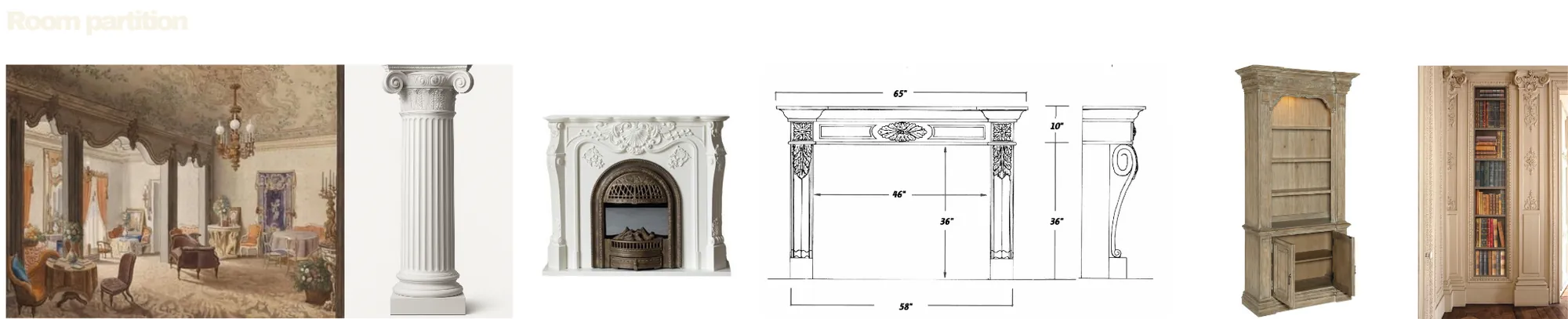

Continuous panorama · Hover to pause · Click to enlarge
05 / From Drawing to Model
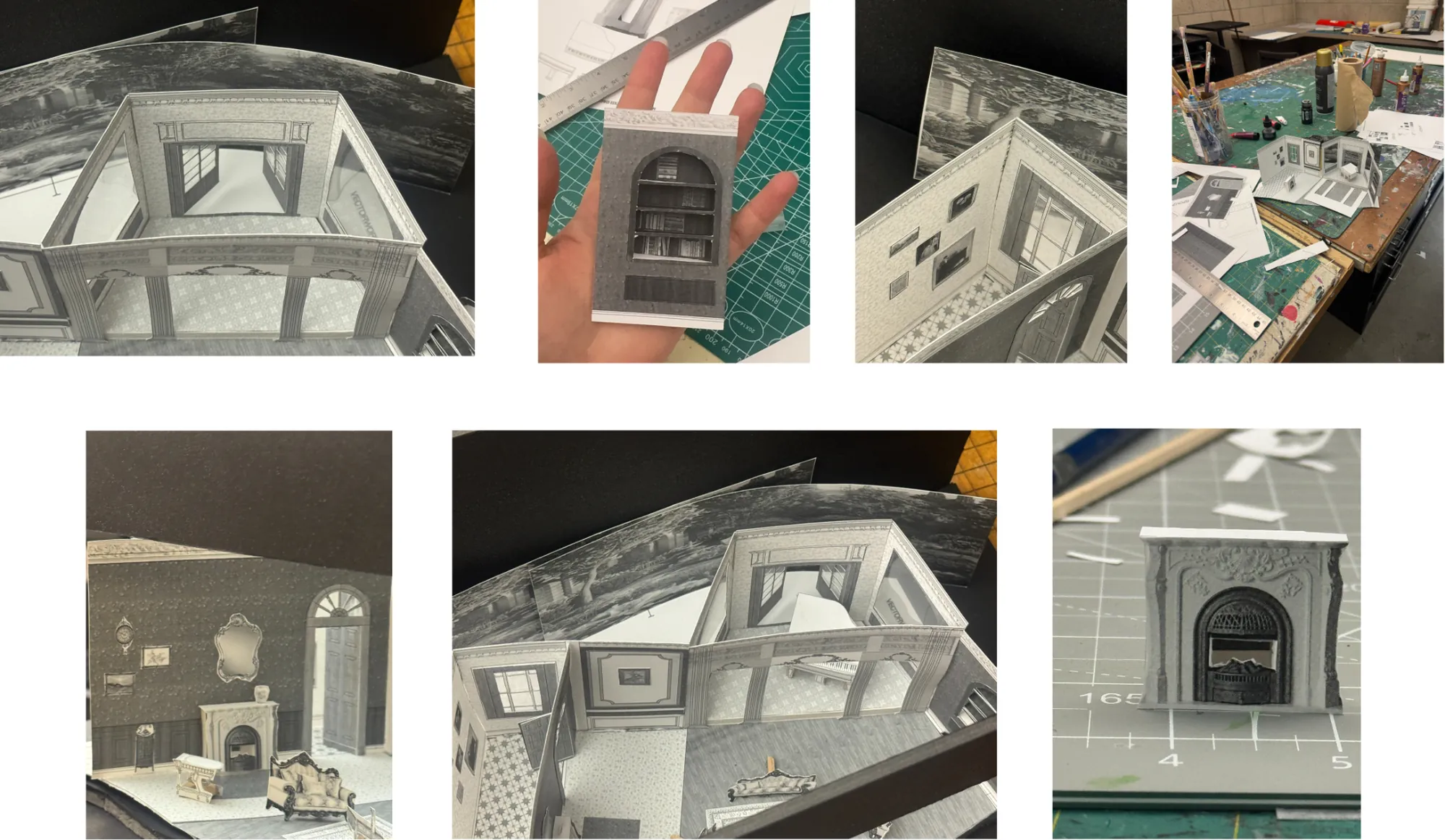
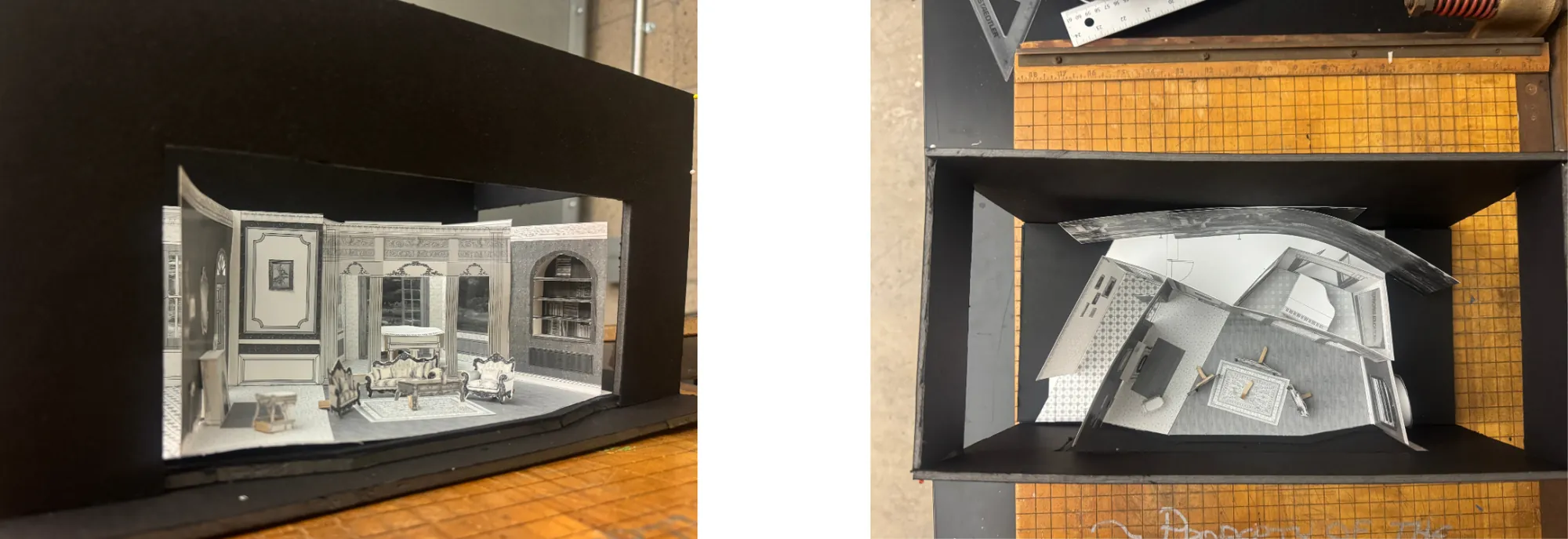
The process moved from elevation studies and architectural details to small paper prototypes and a complete scale model. Repeated testing focused on the balance between symmetry, the openness of the French doors, and the layered relationship between the room and garden.
The final model preserves the elegance of a 1940s sitting room while leaving enough visual depth for light, movement, and supernatural interruption.


06 / Original Introduction Image
An explorable archive of the Universal Century
Team Members: Spike Rao, Annie Cheng, Aliston Ma
01 / Overview
The VR Universal Century Museum is an immersive virtual exhibition set immediately after the events of the One Year War of 0079 in the Mobile Suit Gundam timeline. Designed as a fully explorable museum for the Meta Quest 3, the project guides visitors through humanity's migration from Earth to the space colonies, the political tensions that arose, and the devastating conflict that reshaped the Universal Century.
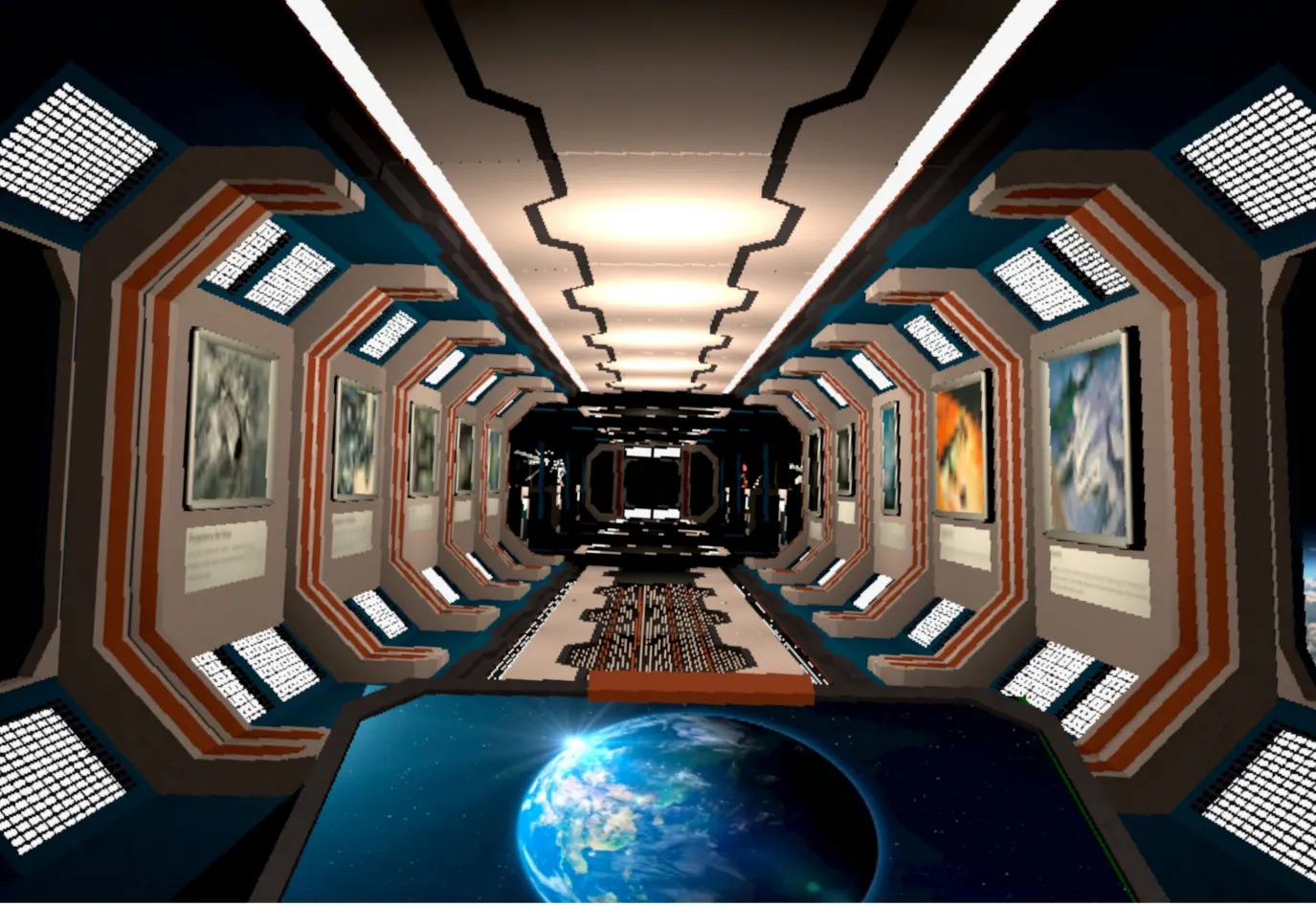
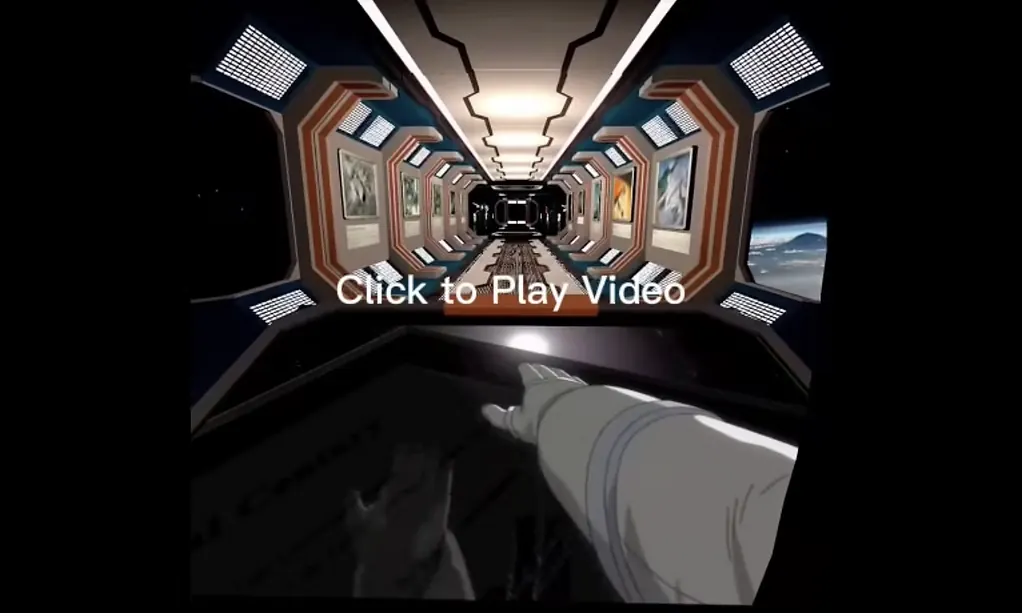
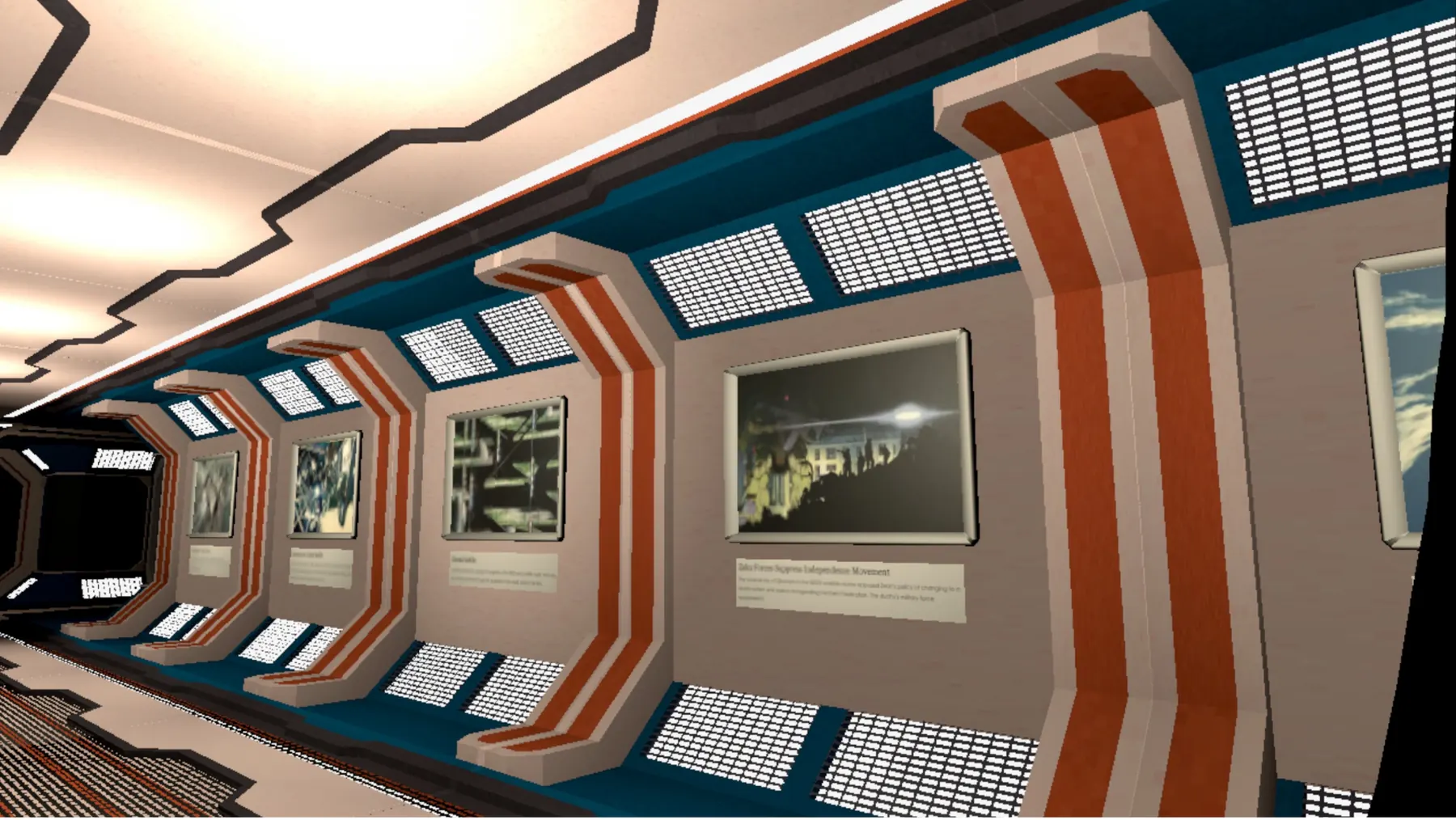
The experience begins in a photo gallery with touch-activated narration. Visitors then enter a 3D model hall showcasing spacecraft, colony designs, and mobile suits, including the RX-78-2 Gundam and MS-06 Zaku II.
Historical narrative and speculative world-building meet through visual storytelling, spatial audio, and hands-on interaction, bringing the Universal Century to life for Gundam fans and newcomers alike.
02 / Collaboration
Exhibit hall, window view, media playback, and object interaction
04 / Design Rationale
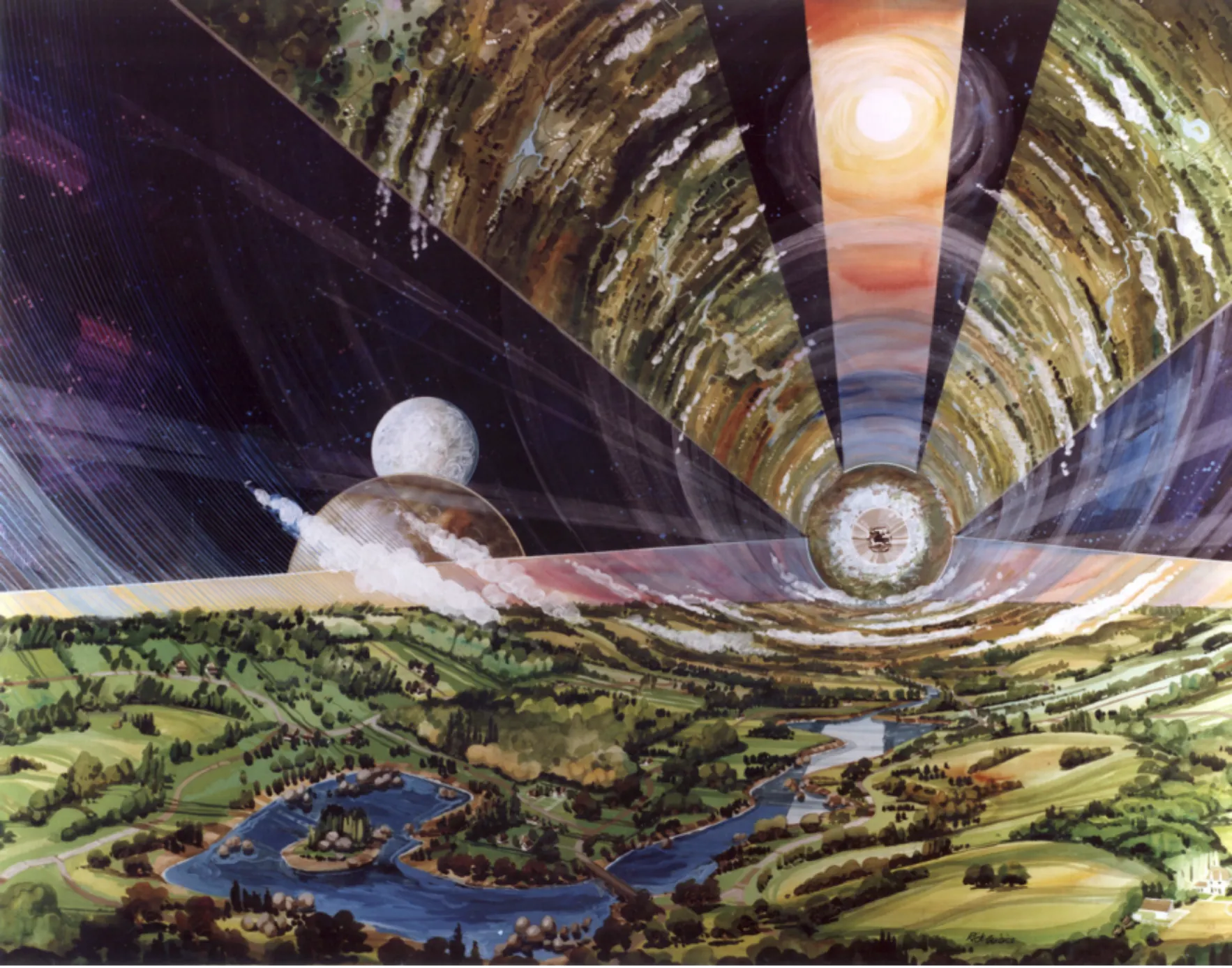
This project reimagines the rich lore of the Mobile Suit Gundam Universal Century as a tangible, explorable cultural institution. By situating the experience after the One Year War, the museum functions as both an archive of a fictional past and a speculative reflection on humanity's future in space.
The design emphasizes commemoration, education, and immersion. It provides context for the socio-political forces behind space colonization and the tragedies of interstellar conflict.
VR transforms passive observation into active engagement: visitors explore at their own pace, discover hidden narratives, and physically connect with artifacts. This interaction bridges historical museum conventions with the possibilities of immersive media.
05 / Spatial Narrative
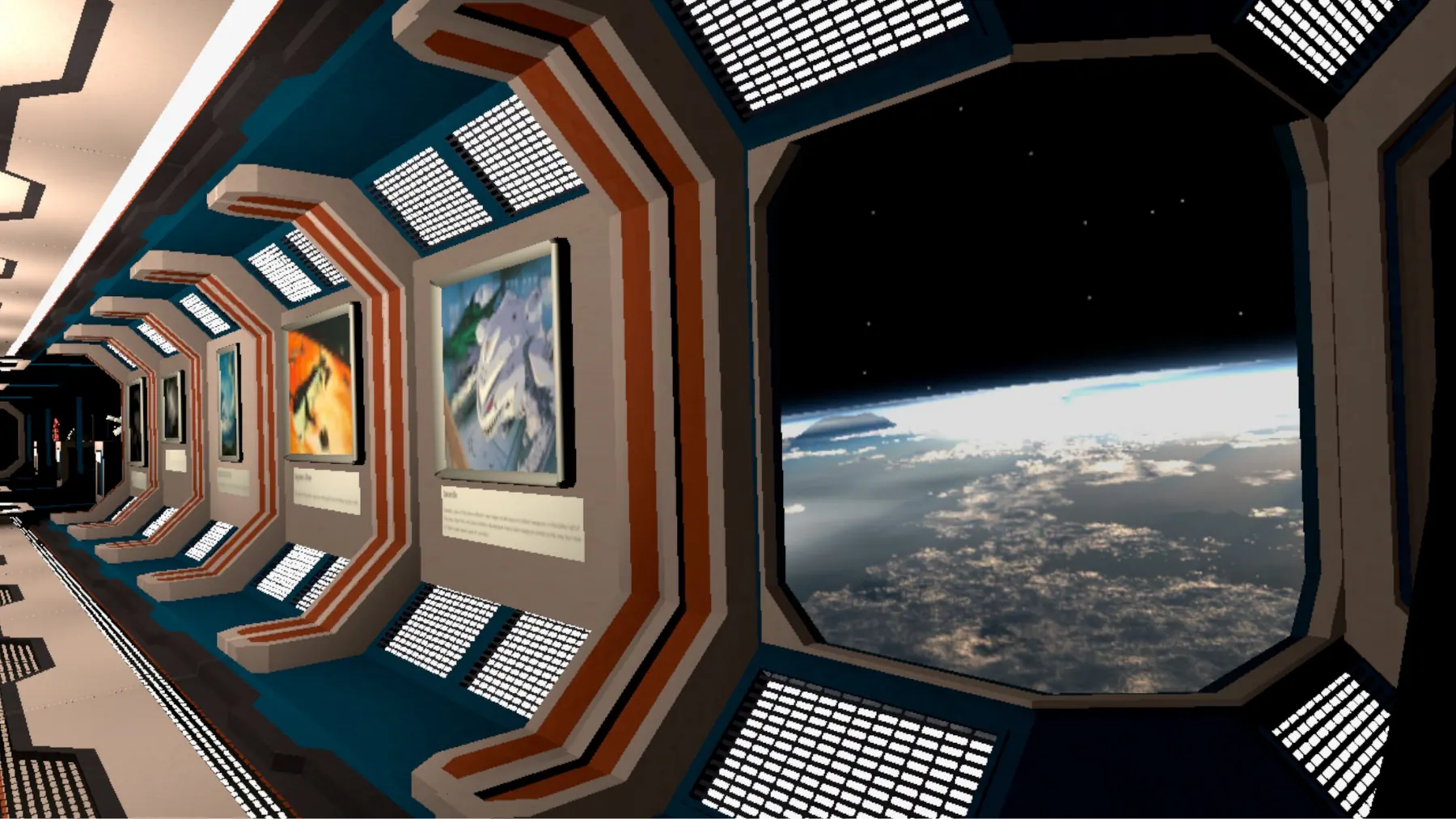
Touch exhibits to hear key events from the history of colonization and conflict.
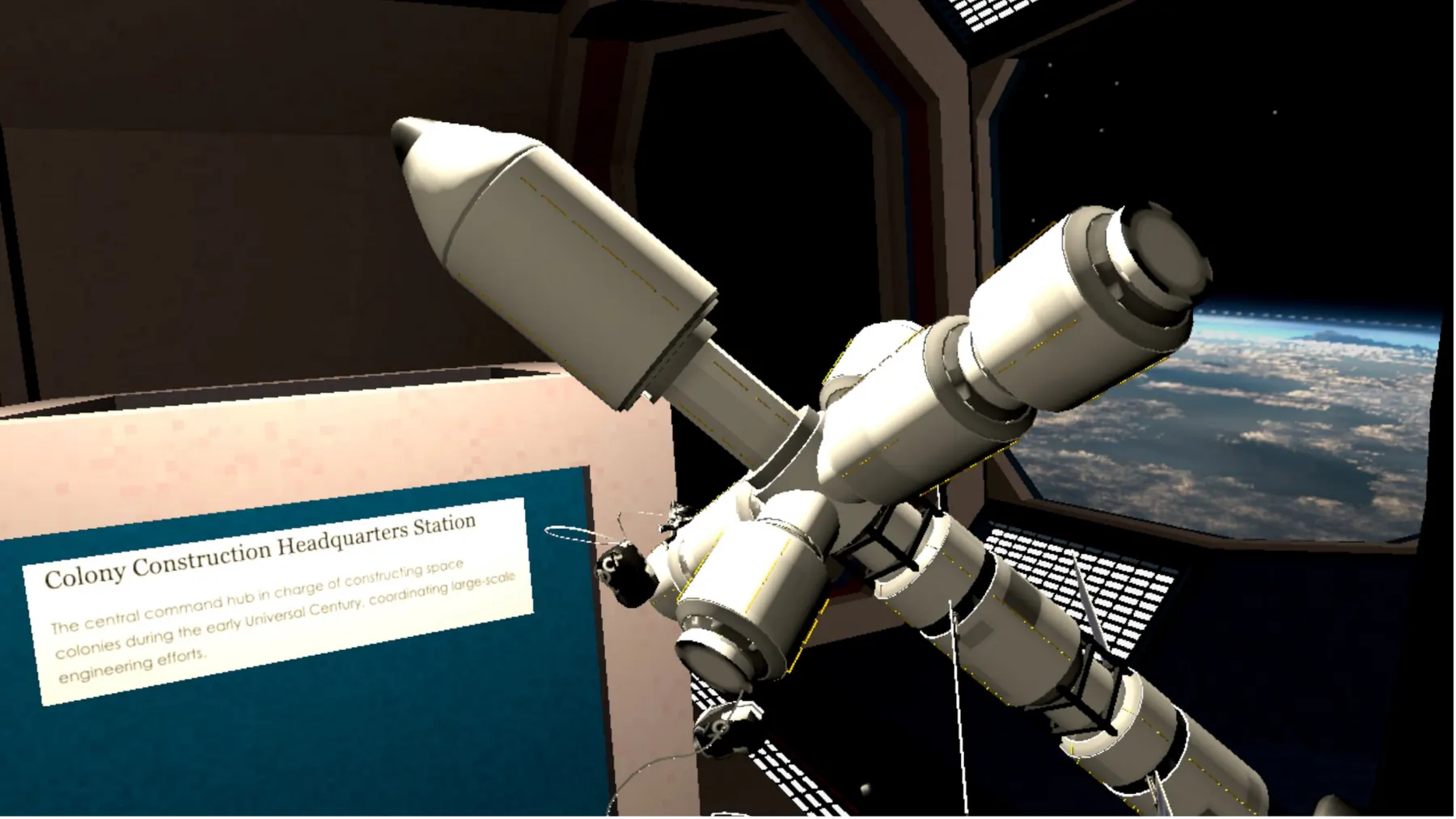
Move among spacecraft, colony structures, and iconic mobile suits at full scale.
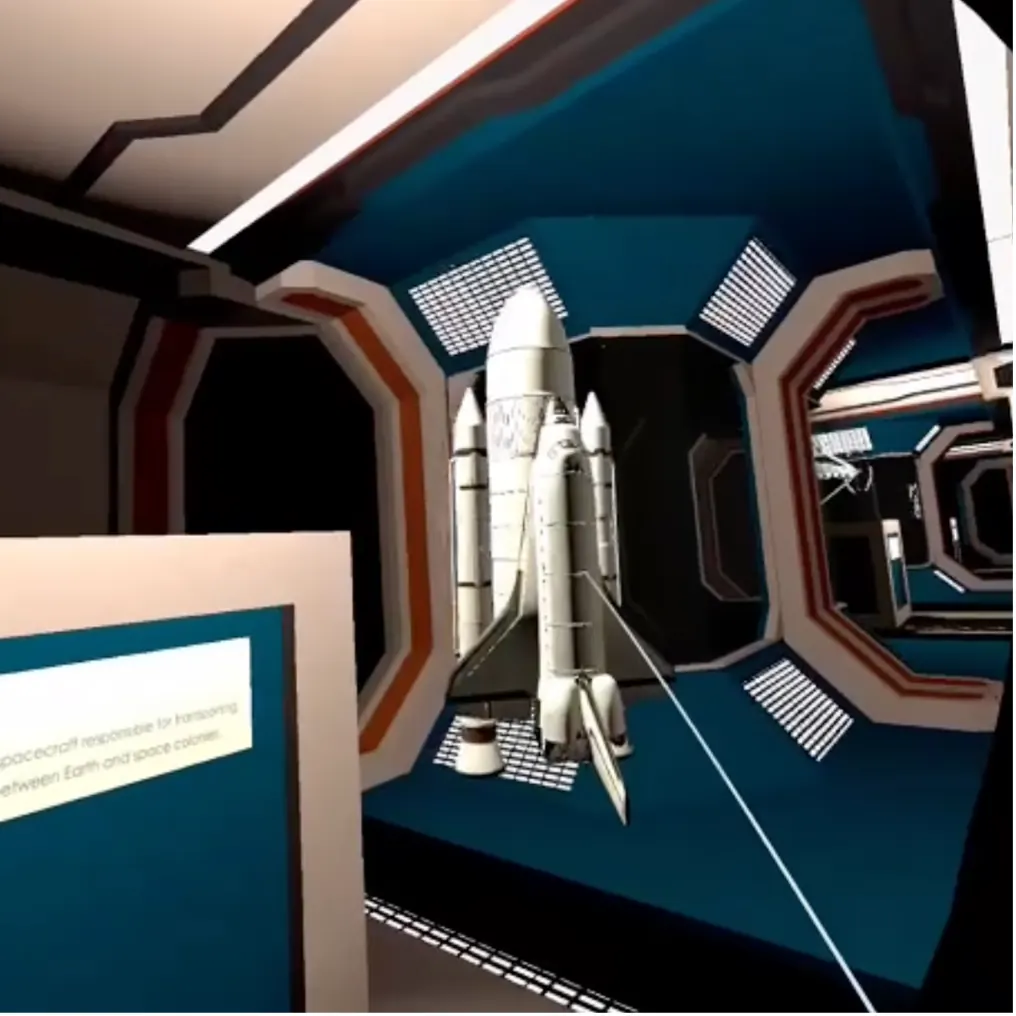
Pick up and inspect 3D objects, then activate introductions and related media.
06 / User Interaction
07 / Production
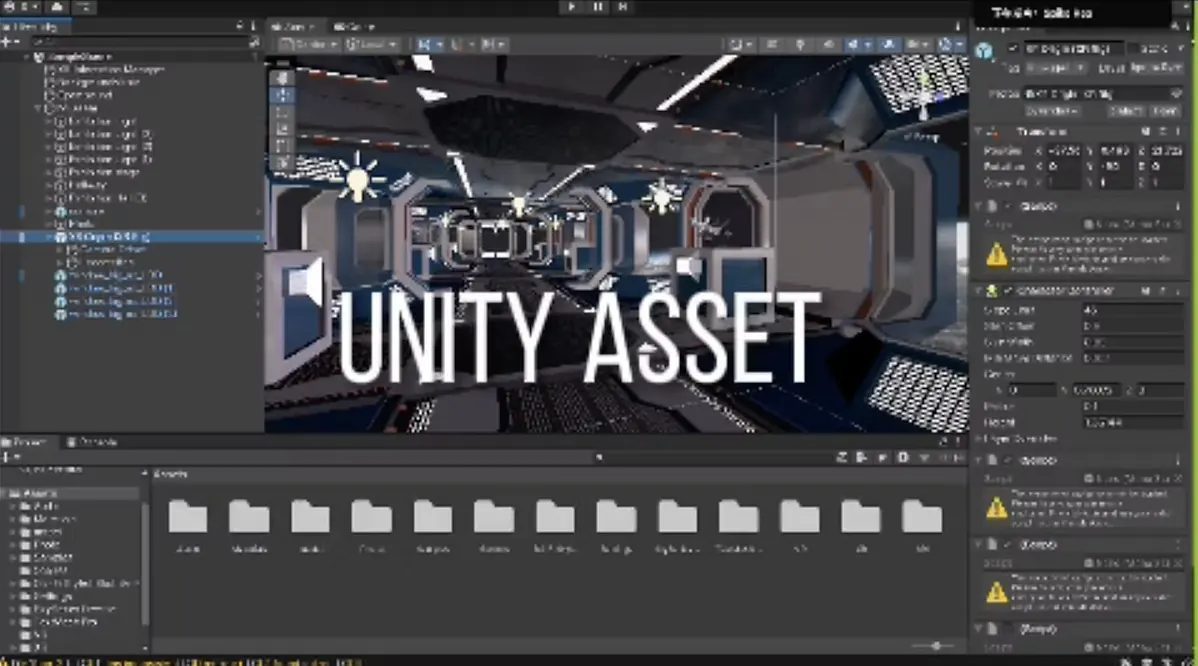
We constructed the futuristic exhibition hall in Unity through 3D environment assembly and dynamic lighting. NaturalReader generated AI audio guides for the exhibits, while ChatGPT assisted with historical image content. Carefully designed background sound supports the feeling of entering a comprehensive space-history archive.
The project combines virtual reality and AI production methods to turn a fictional history into a walkable, responsive museum environment.
Unity 2022.3, XR Interaction Toolkit, Blender, Adobe Photoshop, Audacity, CapCut
Meta Quest 3, VR-ready PC
Custom 3D environments; .GLB and .FBX models of spacecraft, colonies, and mobile suits; voice-over recordings; background music and sound effects
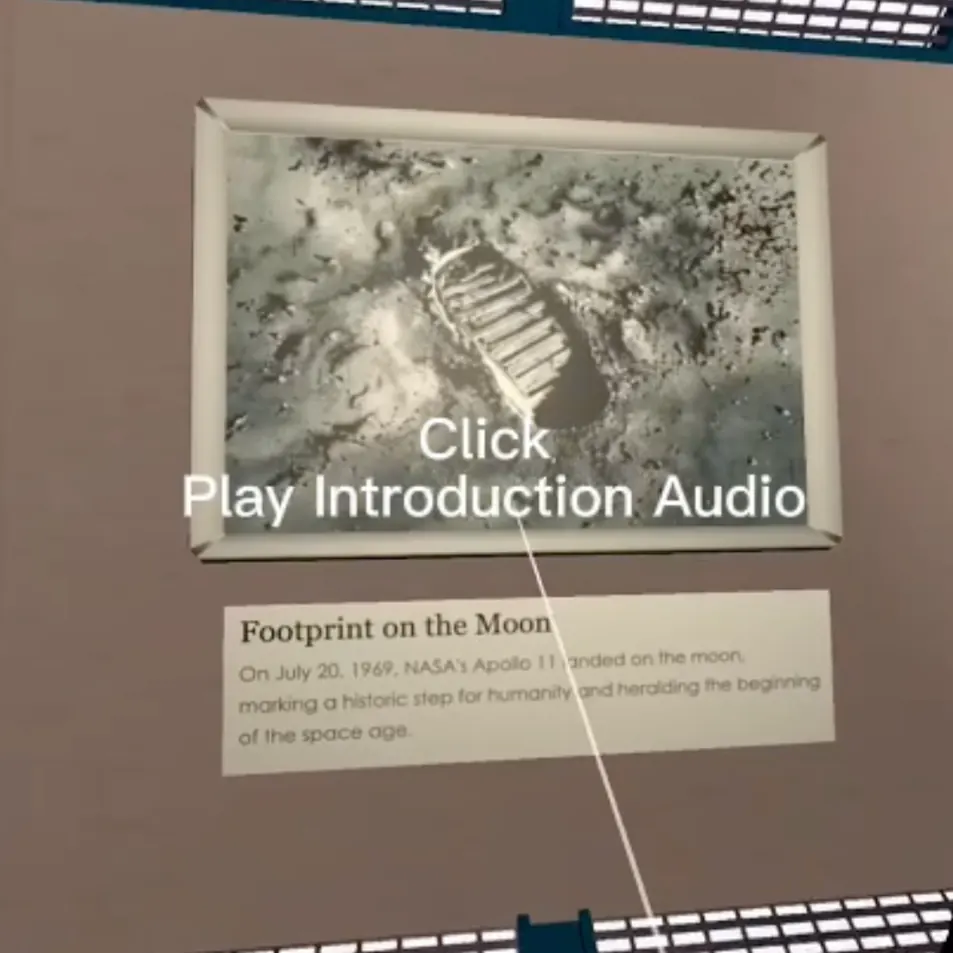
Click to play video, click to hear introductions, pick up and inspect objects
A Chinese garden through the seasons
Space · Atmosphere · Discovery
01 / Project Overview
Seasoned draws on a classical principle of Chinese garden design: a garden should never be seen all at once, but discovered gradually as the visitor moves through it.
This VR experience reimagines that idea as a walkable environment of pavilions, covered corridors, and moon gates. Spring blossoms, summer shade, autumn color, and winter snow transform the world around the visitor.
The project builds on my earlier Vectorworks landscape model, extending a static design into a real-time, immersive environment.
02 / Seasonal Environment
I designed Spring as a small town inspired by a traditional Chinese morning market. Shops, streets, and gathering spaces invite visitors to explore at their own pace.
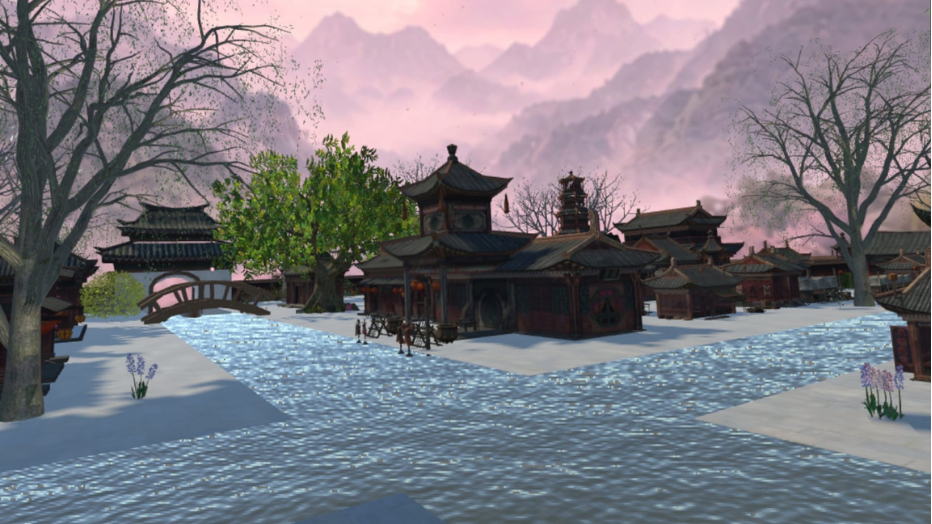
03 / Spatial Design
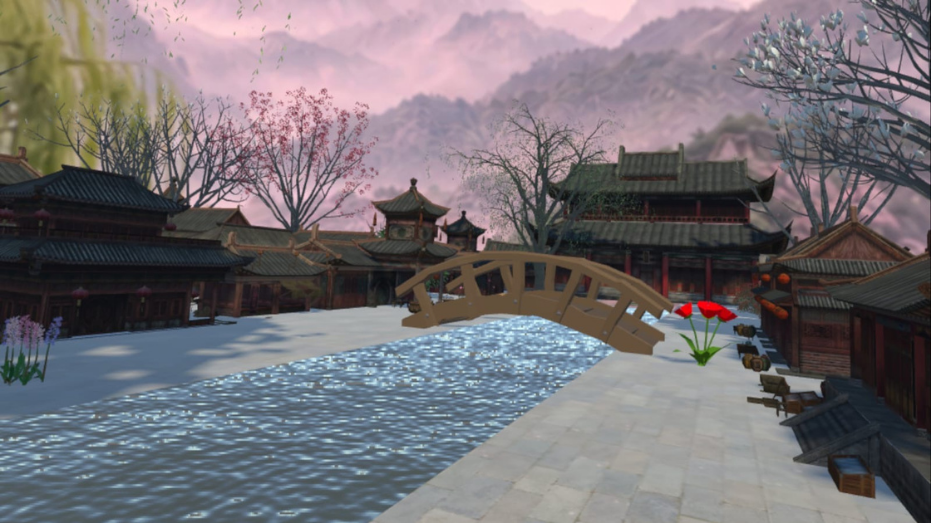
Cross-shaped waterways divide the town into four areas. Small bridges reconnect the canal paths and market streets, creating a sequence of open views and more intimate spaces.
The layout encourages visitors to discover the environment through movement, with architecture and water shaping each new perspective.
04 / Atmosphere & Sound
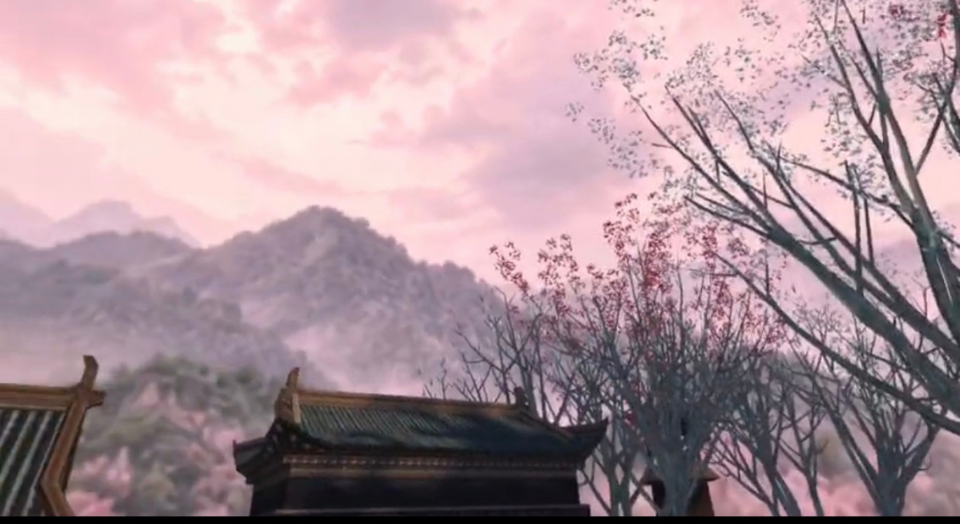
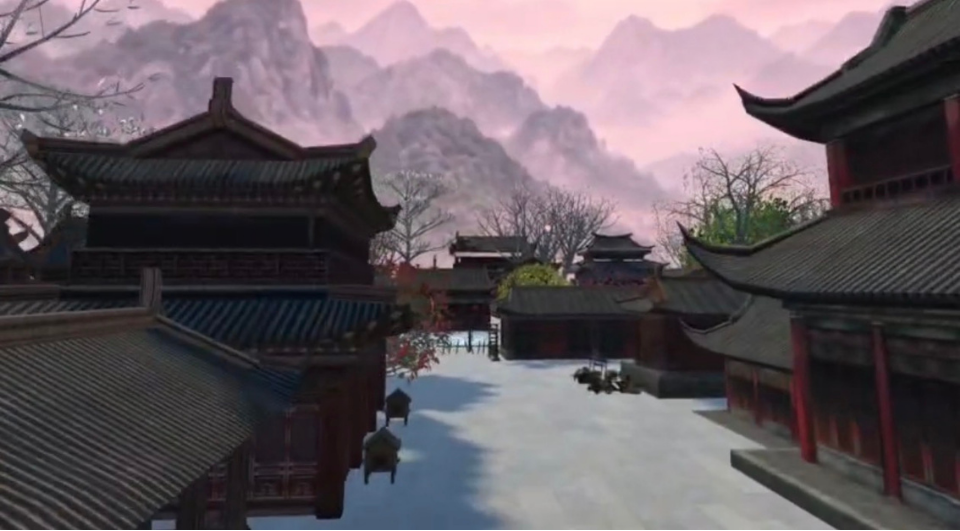
I created an AI-generated pink skybox and adjusted the lighting to give the scene a soft spring atmosphere. Falling petal particles suggest a breeze passing through the trees.
The sound design combines spring-inspired background music with flowing water around the canals, adding another layer to the experience of exploring the town.
05 / In Motion
Explore the town, waterways,
and seasonal atmosphere.
Hi, I’m Annie (Anran).
I work across scenic and spatial design, film, and interactive media. My projects range from stage models and virtual environments to an installation that turns water drops into light and sound. I develop ideas through drawing, model-making, photography, and experiments with materials and technology.
I’m also interested in how creative work comes together behind the scenes. Through theater productions, documentary filmmaking, and live events, I’ve taken on roles in both design and production. These experiences have shaped how I collaborate, work through practical challenges, and carry an idea from its first sketch to an audience’s experience.